
Know Which EPA Rules Apply to Your Yard.
Before the Inspector Does.
A fueling island, a used-oil tank, a wash bay, a parts washer — each one can trigger SPCC, hazardous-waste, stormwater, air or tank rules most fleets never knew applied. X3 Environmental maps your facility to the 40 CFR programs that actually apply, scores your readiness, and builds the plan and the records before anyone with a badge shows up.
Most Fleets Trip EPA Rules They Didn’t Know Applied.
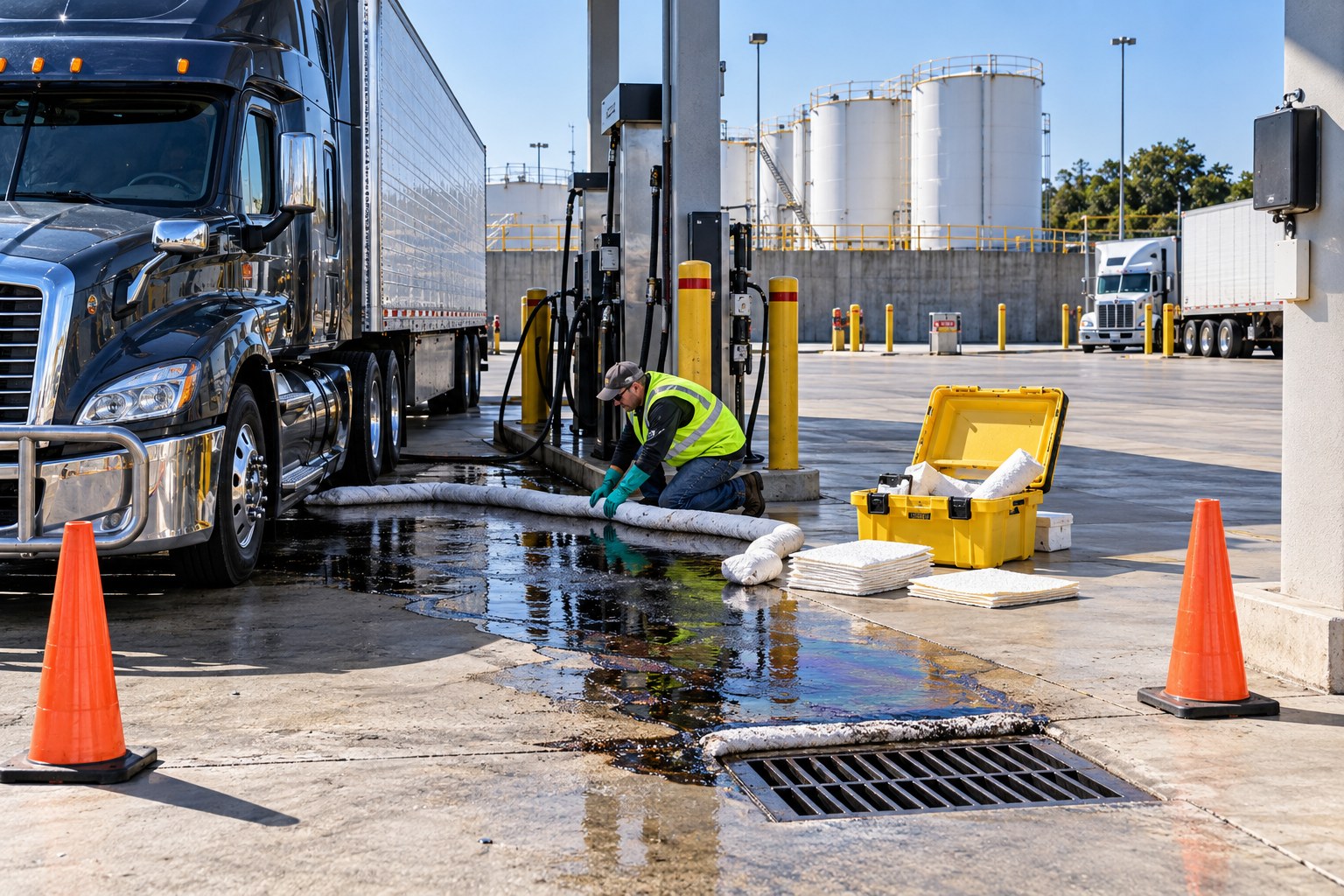
DOT tells you when it’s coming. EPA and the state don’t. Cross 1,320 gallons of oil storage and you owe an SPCC plan. Generate a few drums of solvent a month and you’re a hazardous-waste generator with labels, logs and training to prove. Wash trucks outside and you may owe a stormwater permit and a pollution-prevention plan. Let a fuel-island spill reach the storm drain and you may owe a report before the day is out. None of it lives in the DOT playbook a safety manager grew up on — and every one of them carries a fine that starts in the thousands per day.
The problem isn’t the rule you know. It’s the one you didn’t know applied to your yard.
Your Facility In. Readiness Out.
Tell X3 what’s on the yard — tanks, fueling, wash bays, parts washers, waste streams, drains — and it maps your operation to the EPA and 40 CFR programs that apply, scores your readiness across every area an inspector reviews, and ranks the gaps by risk.
Which programs apply to this yard — and which don’t, so you stop guessing.
Are you over the oil-storage threshold, and is the plan, containment and inspection log in place?
Generator status, accumulation time, labels, manifests, training — where would RCRA cite you?
Permit coverage, SWPPP, benchmark monitoring; UST release detection and AST inspections.
Permit thresholds for fueling, coatings and generators; used-oil handling and records.
What to close first, ranked by penalty exposure and inspection likelihood.
Stop wondering what applies. Start knowing your score.

One Number. Every Program Behind It.
A sample terminal, the way X3 shows it: the score, the programs that apply, the gaps that would be cited, and what to fix first.
- Oil storage totals 2,100 gal — SPCC plan required, none on file (40 CFR 112.3)
- Wash-bay discharge reaches a storm drain — industrial stormwater permit coverage needed (40 CFR 122.26)
- Used-oil tank unlabeled; no monthly containment inspection log (40 CFR 279.22)
- Two employees handling waste have no RCRA training record (40 CFR 262.16)

Every Area an Inspector Reviews. Cited to the Rule.
X3 covers the six programs that hit fleets and facilities — scores your readiness in each, cites the section it would be written up under, and flags where your state runs a stricter delegated program.
Six Programs. One Yard.
SPCC
Oil-storage thresholds, secondary containment, the plan and the inspection log.Hazardous waste
Generator status, accumulation limits, labels, manifests and training.Stormwater
Industrial permit coverage, the SWPPP and benchmark monitoring.Storage tanks
UST release detection and testing; AST inspection records.Air
Permit thresholds for fueling, coatings and generators — and the state permits on top.Used oil & records
Used-oil handling, wash water, and the records an inspector asks for first.

Finding the Gap Is Only the Beginning.
X3 turns each gap into a documented sequence — the plan, the records, the training and the proof — so the facility is ready on the day, not the week after the notice.
Profile the yard
Tanks, fueling, shop, wash bay, waste streams, drains — the operations that trigger programs.
Map what applies
Each program mapped to your facility, with the threshold and the section — and what doesn’t apply.
Score & rank
The readiness score, and the gaps ordered by penalty exposure and inspection likelihood.
Build the documents
SPCC and SWPPP-style plans, waste determinations, labels, inspection logs and training records — generated from your profile.
Train & assign
Who needs RCRA or SPCC training, who owns the monthly inspection, when the next one is due — and what the shop does in the first ten minutes of a spill.
Report on time
Tier II applicability flagged with its March 1 deadline — you file with your SERC, LEPC and fire department.
Prove it
The readiness review, the specialist work products and your permits, each with its cite — the material for the binder an inspector expects.
Map. Score. Fix. Document. One continuous workflow.

Inspection-Ready Every Month. Not Just After the Notice.
Environmental compliance is a calendar: monthly containment inspections, annual training, tank testing, permit renewals, the Tier II deadline every March. X3 keeps your permit and renewal dates in your account, flags anything expiring within 60 days on your dashboard, and re-scores the facility every time you re-run the readiness check.

Inspections, training expirations, tank tests, permit renewals, reporting deadlines.
The obligation that slipped, the program it belongs to, the cite it would be written up under.
To the shop lead, the terminal manager or the owner — with the date.
Each closed item lands in the facility record with its log and its date.
Your terminal manager shouldn’t rediscover the SPCC plan every time someone asks. It should already be current.
See Every Yard’s Exposure Before the Inspector Does.
One view of every facility’s readiness, the programs that apply to each, the open corrective actions and the next deadline — the answer to “which yard would fail first?”

One yard or fifty. One answer to “what would they find?”

Terminals, Shops, Fuel Islands and Wash Bays. Each One Profiled.
Any facility that stores fuel or chemicals, generates waste, or drains to the street has obligations — and they differ by what’s on the ground and which state it’s in. X3 profiles each site on its own, flags where a state runs a stricter delegated program than the federal baseline, and rolls every yard up into one picture.

Walk the Inspector Through the Yard. Not Around It.
An environmental inspection at a fleet that knows its programs is a walk and a binder. At a fleet that doesn’t, it’s a notice of violation and a consultant. X3 Environmental puts your yard in the first group — the plan on file, the drums labeled, the logs current, and the record ready before anyone asks.
See which program applies before it’s a finding.
Close the gaps with the most penalty exposure, with an owner and a date.
Walk in with the plan, the logs, the training records and the cites.
One Plan That Scales With Your Fleet.
Every tool included, every facility included — and the bigger you get, the less you pay per power unit.
- ✓Facility Readiness Score & applicability map
- ✓SPCC, SWPPP & waste-determination builders
- ✓Audit checklist, storage timer & permit manager
- ✓Twelve grounded AI environmental specialists
- ✓Unlimited facilities and carriers as you grow
| Up to 10 power units | $99 |
| 25 power units | $249 |
| 50 power units | $499 |
| 100 power units | $749 |
| 250 power units | $1,499 |
| 1,000 power units | $5,249 |
Compliance guidance grounded in EPA and 40 CFR requirements — not legal advice, not a filing service, and not affiliated with EPA, FMCSA or any state agency. Confirm state-specific requirements with your regulator; the facility owner remains responsible for compliance.
Frequently Asked Questions.
What fleet owners and terminal managers ask before they put X3 over their yard.

What is X3 Environmental?
Which facilities does this cover?
How does X3 know what applies?
Do you file with the EPA or the state for me?
What if my state has stricter rules?
Does X3 monitor continuously?
What happens when something slips?
Does it work across multiple terminals?
Does AI replace our environmental consultant?
How does pricing work?
How fast can we be inspection-ready?
You Already Know What’s on the Yard. Now Know What It Requires.
Profile your facility and X3 shows you the score, the programs that apply, the gaps that would be cited, and the binder you’d hand the inspector.